In the increasingly competitive SaaS industry, being ‘always on’ has become non-negotiable. It means your application must be available, and performing optimally, 24/7/365. Any downtime or performance setbacks put your reputation, and bottom line, at risk.
In this blog we’ll explore what the concept of being always on really means for modern SaaS companies and why it’s so challenging to achieve without the right infrastructure in place.
The ‘always on’ expectation in modern SaaS
Today’s SaaS platforms operate under a constant expectation of availability and customers won’t tolerate imperfection. SaaS applications need to function perfectly, all the time - and that means SaaS application hosting needs to be just as reliable.
As a cloud-native industry, SaaS organizations have traditionally relied on hyperscale cloud providers. Following the ‘cloud boom’, advertising hype surrounding hyperscale cloud’s elasticity, flexibility and minimal upfront costs made it the go-to choice. But, over time these environments have revealed additional complexities: spiraling bills, lack of hardware-level control, performance degradation, and over-reliance on single points of failure.
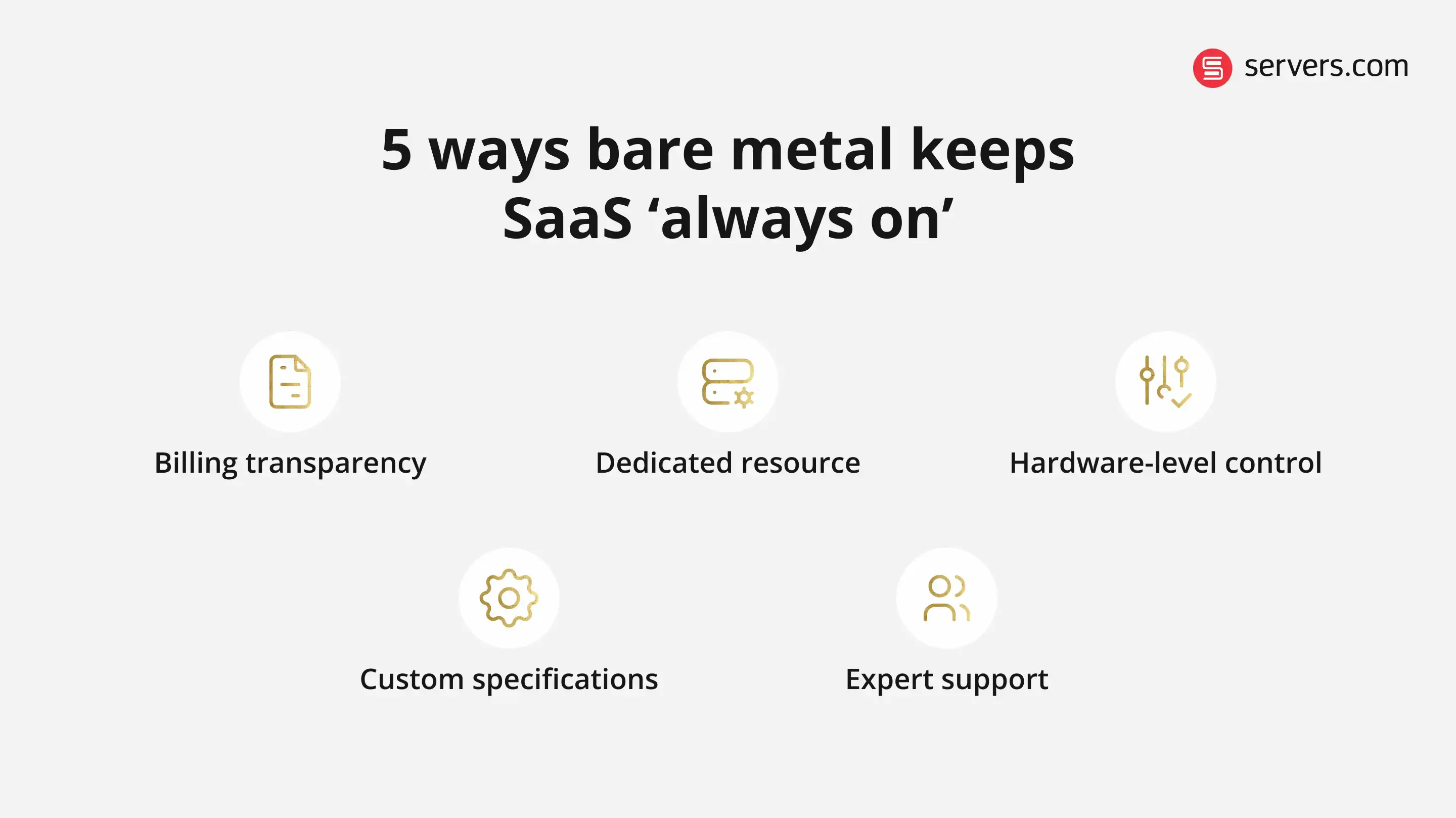
As SaaS market competition reaches new heights, hyperscale cloud-first strategies are fast becoming more of a competitive disadvantage. As a result, SaaS teams are landing on bare metal to achieve the reliability and performance they need.
The challenge of staying ‘always on’ in hyperscale cloud
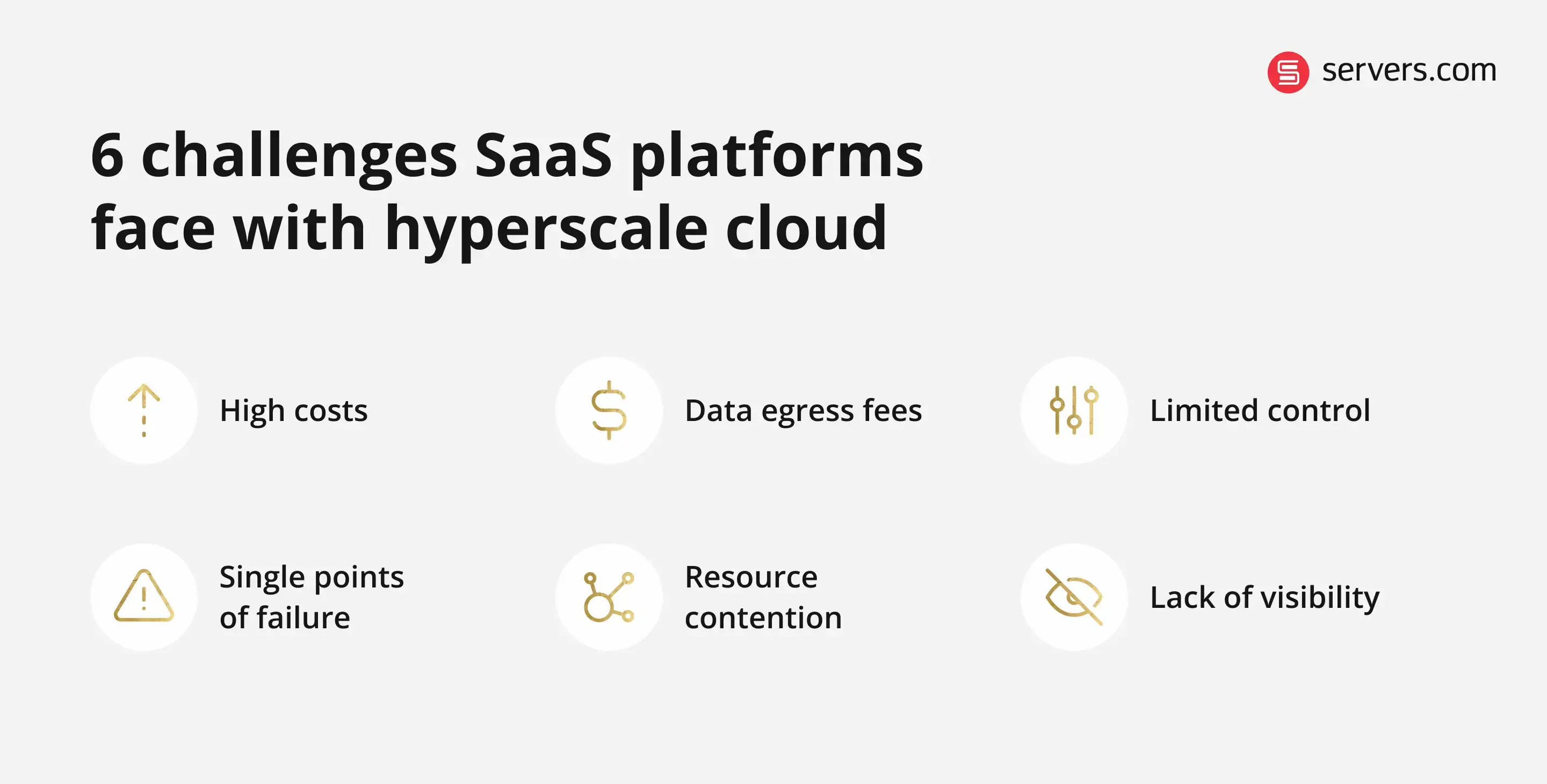
Remaining always on is operationally and technically challenging as it involves remaining performant at high volume whilst also keeping margins tight and ensuring compliance. There’s no doubt that hyperscale cloud solutions excel in providing the rapid elasticity needed to scale fast. However, when relied on exclusively, these environments present additional challenges that will compromise a SaaS platform’s ability to keep the always on promise.
1. Cost management
Hyperscale environments are built to provide massive elasticity, but it comes at a price. Virtualization overheads and unpredictable usage-based pricing means costs quickly spiral out of control. Research conducted by CloudZero found that for 73% of SaaS companies, cloud service provider costs represent at least 20% of their total cost of goods sold (and for the remaining 28% that ratio rises to more than half).
“For SaaS companies, the cloud is typically a top three budget line item - yet most don’t have rigorous processes for managing their cloud efficiency or understanding the relationship to their unit economics at any level of granularity,” comments Phil Pergola, CEO of CloudZero.
Pushing to remain always on whilst relying solely on hyperscale cloud contracts is an expense that most SaaS organizations won’t be able to maintain long-term.
2. Data egress fees
On top of standard billing, data egress is another cost center. Public cloud providers charge egress fees each time data leaves their network. Since SaaS platforms handle vast volumes of data flowing across geographies, it means egress fees can become a significant expense.
Amazon S3, for instance, charges $0.02-0.09 per GB so syncing 10TB of data each month between us-east-1 and eu-west-1 regions could cost in excess of $900, depending on the regions involved. As a platform scales globally, egress fees spiral (even more so if replication is enabled and forgotten).
As Ievgen Nagorny, CTO of MGID, told servers.com:
“One of the prevailing concerns with cloud solutions is the unpredictability and non-transparency of costs. The fact that there are numerous companies providing cloud cost optimization services is testament to this problem. Businesses often find themselves paying for hidden costs or unnecessary resources, making budget management challenging”.
3. Security and compliance
SaaS companies fall under stringent security and compliance requirements related to data protection and privacy. Even if your infrastructure runs entirely on virtualized infrastructure, you are ultimately responsible for securing your customer’s data, configuring your services compliantly, and adhering to required controls.
Ultimately, whilst a hyperscale cloud provider’s global infrastructure will allow SaaS platforms to operate in regions worldwide, it remains the responsibility of the SaaS platform to manage data residency compliance in accordance with local laws (GDPR, CCPA, UK/EU Data Acts).
Due to the limited manual control and transparency hyperscale cloud environments provide over underlying hardware and network layers, it can be difficult to monitor and uphold these provisions. For a multinational SaaS organization mobilizing these services, there’s always the risk of inadvertently storing customer data in non-compliant regions due to in-platform data misconfigurations that the business has little-to-no control or oversight over.
4. Ensuring resilience
Part of being always on is remaining seamlessly operational even in the face of hardware failures and network outages. At the same time, one of the biggest misconceptions around hyperscale cloud is that it never fails - and it means that many businesses don’t have robust redundancy strategies in place.
The reality is that even the most established vendors or the most high-performance servers aren’t immune to failure. Even if a hyperscale cloud provider replicates its services across availability zones, vulnerabilities still exist.
Following the recent wave of outages hitting the likes of AWS and Cloudflare, it’s a fact that’s becoming harder to ignore. Isaac Douglas, CRO of servers.com explains:
“Cloudflare’s outage is a good reminder that ‘the cloud’ still runs on very real, very imperfect infrastructure. No matter how ‘premium’ the platform, it will have bad days: cloud providers go down, CDNs go down, DNS providers go down. The goal isn’t perfection; the goal is resilience.”
One thing is clear: in the race to stay always on no single vendor is an antidote to performance woes. Building resilience means avoiding single points of failure altogether.
5. Maintaining consistent performance
Vendor outages aren’t the only risk to SaaS platform performance. Variable latency and slowed down response times are frustrating for end user customers and risk undermining service promises made to enterprise clients at sign up.
Loss of infrastructure control in virtualized, public cloud environments means that you’re dependent on the provider’s underlying network stack and that customization is limited. Plus, because these environments involve hardware sharing, there’s always the risk that another tenant’s heavy workload will degrade your own platform’s performance.
Add the notoriously slow and sparse support typically offered by hyperscalers into the mix and the chances of getting a quick fix to hardware issues compromising your platform’s performance are slim. For latency-sensitive SaaS platforms, this kind of multi-tenant, obfuscated environment introduces a level of performance variability that risks undermining the industry standard.
6. Managing continuous testing
Continuous development, testing and integration is a core part of maintaining a high-performance SaaS platform. Testing must be completed at every stage of the SaaS platform development process to ensure regular bug fixes and updates. However, if not carefully managed, these testing workloads can increase the risk of temporary downtime from performance bottlenecks under the additional load (something that is exacerbated even further by the rapid release cycles typical of SaaS models).
In public cloud environments where there’s limited control over your hardware and less flexibility to define custom infrastructure tuning or hardware-specific testing, it becomes harder to maintain and monitor these testing environments efficiently. Software bugs and misconfigurations become harder to diagnose, noisy neighbors can result in overloaded servers, and the absence of robust failover mechanisms risks more serious downtime.










![Reasons why companies are leaving hyperscale cloud [with examples]](/dA/845f390047/image/companies-leaving-cloud.webp?language_id=1)