Network
Audio advertising has come a long way since the first ever radio commercial aired back in 1922. Today, audio advertising is a growing medium across digital media platforms. And it’s clear to see why. Programmatic audio holds the key to a wide range of new ad formats, from podcast to in-game ads to interactive experiences on smart home devices.
But the success of programmatic audio advertising hasn’t come without challenges. Challenges like buyer hesitancy, growing concerns around ad fraud, and inconsistent measurement and attribution. As a result, while programmatic audio has continued to grow steadily, there remains a 22% engagement gap between consumer engagement and advertiser investment.
This whitepaper explores the state of audio advertising in today’s ad ecosystem. Covering the origins of audio ads through to today’s consumer audio boom, the paper delves into the growth of programmatic audio; those ingredients that make audio advertising so effective; the biggest trends emerging in the audio ad ecosystem; and the key infrastructure requirements for ad platforms today.
Audio ads have traditionally been synonymous with live radio. But today, more of us are consuming digital audio content. Tuning in to music streaming, podcasts, gaming, and digital radio platforms is a daily activity for many. And that means opportunities for audio advertising are growing rapidly.
According to Nielsen and Edison Research, average daily audio consumption in 2025 amounted to 3 hours and 53 minutes of daily listening across both ad supported and ad free platforms. And in the third quarter of 2025, ad supported audio accounted for 64% of all listening. In 2026, global digital audio ad spend is expected to surpass $7.9 billion, with programmatic expected to account for approximately one third of total digital audio ad spend.
Audio advertising remains fast-growing, with brands continuing to introduce the format into their marketing strategies.
AT&T aired the first ever paid radio commercial on August 28, 1922, on a New York radio station called WEAF. The first commercial to hit the airwaves was a real estate ad by Queensboro Corporation New York, at a cost of $50 for a series of five programs. And with that, broadcast advertising as we know it today was born.
The business concept was as simple as it was innovative. Radio could sell time. “Time measured in exact minutes and seconds on a communication system for hire”, as reporter John McDonough aptly puts it.
Skip forward to 2026 and audio advertising is experiencing a second renaissance, fueled by the booming popularity of streamable audio content. These days audio ads are being delivered via online streaming platforms such as Spotify and YouTube, podcast platforms like Acast, and as part of in-game ad placements.
Streamable content is all around us. Listening to music on the go or whiling away the morning commute accompanied by a podcast are commonplace activities for most of us. Reflecting this, Spotify’s advertising revenue is set to reach $2.2 billion by 2027 (up from 1.56 billion in 2022).
Spotify platforms allow for digital audio ads of up to 60 seconds, with the ads placed between songs and during podcasts. And whilst Spotify is currently the global leader in music and podcast consumption, there are many other channels embracing audio ads too. Channels like Apple Music, Acast, Sonos, and YouTube.
It’s not hard to understand why. Digital audio advertising is more accessible than traditional broadcasting. The medium broadens audience reach and provides advertisers with highly granular targeting opportunities. With digital audio, advertisers can place their ads directly where their audiences are - alongside select podcasts, artists, or digital radio shows that share similar audience demographics.
Direct audio advertising is a manual process. Buyers negotiate on audio ad inventory (the advertising space a publisher has available and puts up for sale) before serving it on their desired platform. The prices of ad inventory and ad space are flexible, and direct negotiations lend themselves to sourcing premium inventory. But buying and selling directly can be slow and expensive. Cost per thousand impressions, otherwise known as cost per mile (CPMs), is typically high since each ad placement is bespoke to the individual buyer.
Programmatic audio advertising is an automated process. Ad inventory is purchased and exchanged online via real-time bidding (RTB). Bids are placed simultaneously in programmatic auctions with the highest bidder winning the inventory slot. Programmatic requires no person-to-person negotiation. An advertiser will just set various parameters such as budget, ad placement, and audience preferences for their campaigns.
Programmatic advertising has seen great success across ad types. The global programmatic advertising market size is projected to reach $2.753 billion by 2030, marking a 22.8% CAGR between 2024 and 2030. Yet video and display advertising remain the largest market segments with audio having taken a back seat.
For many years, limited publisher interest in programmatic audio and the absence of suitable technologies for cross-platform delivery kept investment in the medium relatively low.
It wasn’t until 2014, when the Interactive Advertising Bureau (IAB) created a new ad-serving protocol, that this all started to change. The Digital Video Ad Serving Template (otherwise known as VAST) created a shared language for advertisers and publishers. And in 2018, a new “adType” attribution was introduced to support audio-only advertisements.
Within the adType attribution, audio ads could take three different forms: companion ads (banner ads displayed alongside an audio ad), ad pods (audio ads distributed across set slots within content), and skippable ads (pre-roll and mid-roll audio ads).
VAST paved the way for the adoption of programmatic audio advertising on a much greater scale. But the growth of the medium has been gradual. Even though companies like Google, Acast, and Rubicon all incorporate programmatic audio ads within their platforms, limitations around scale, measurement, and standardization have continued to stifle advertiser investment.
It’s not all bad news, however. With measurement and fraud prevention strategies continually improving, the true benefits of programmatic audio are becoming more accessible to advertisers. So much so that programmatic audio ad spend grew 200% between 2020 and 2025.
“With the sustained popularity of podcasts, music streaming, and emerging voice-activated devices, programmatic will continue to grow,” comments Amir Sharer, Founder and CEO of Brave. “Audio provides a personalized, screen-free way to engage, enhancing visual programmatic campaigns. This makes it a vital channel for brand storytelling and connecting with audiences.”
A joint study by Acast and OMD has found that podcast advertising delivers a return on ad spend (ROAS) of 4.9, outperforming traditional media and making it one of the most profitable media channels. The study also found podcast advertising to be 34% more cost-effective in driving brand awareness compared to traditional media.
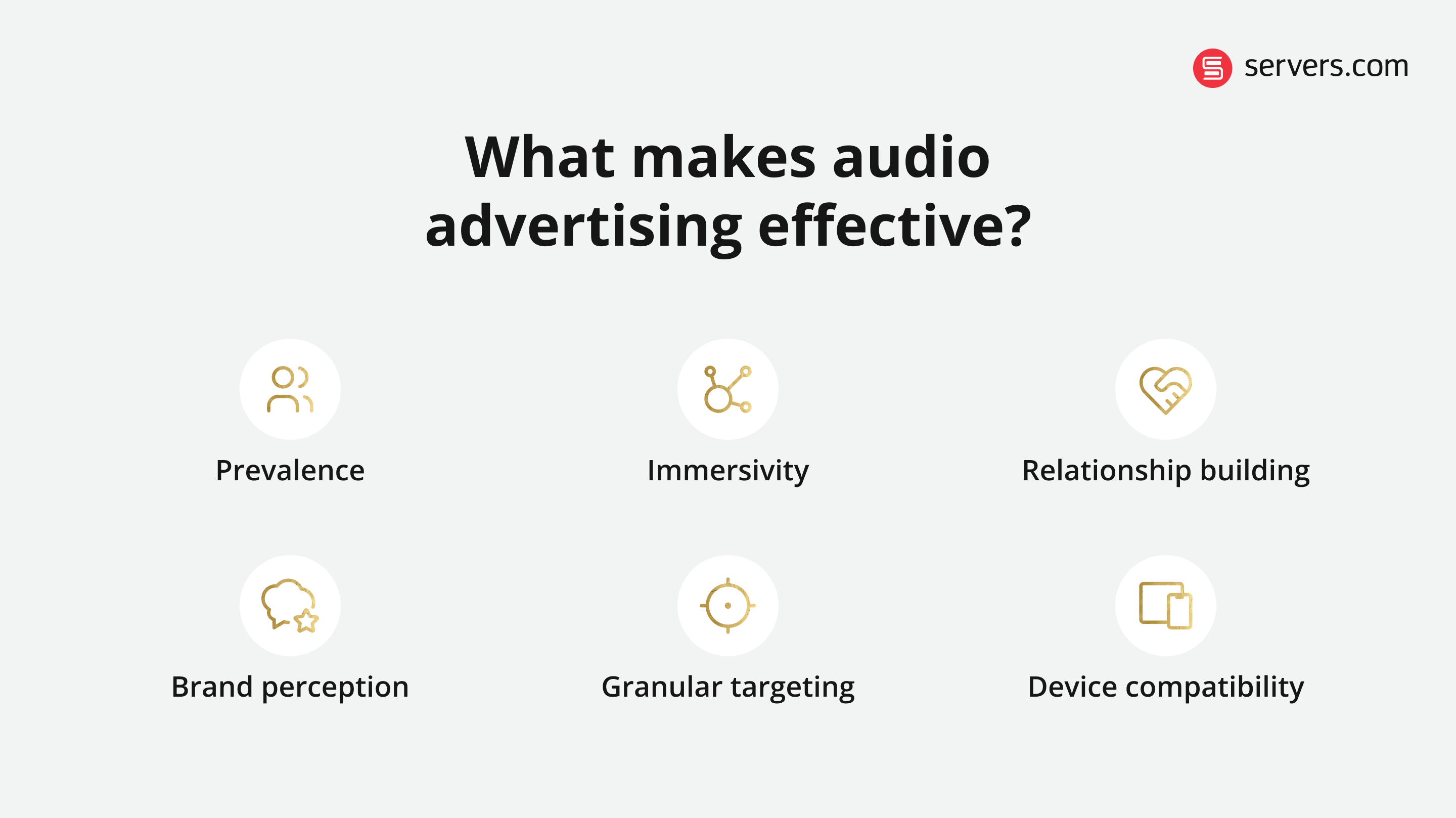
So, what exactly is driving these impressive results?
Over 800 million people worldwide subscribe to a paid music streaming platform, and people are investing a lot of time on these platforms. The average American listens to more than 27 hours of audio per week.
Digital audio is immersive, engaging, and personal. Research conducted by Spotify and Neuro-Insight found that digital audio is more engaging than radio, TV, and social media. Using steady state topography technology to measure brain activity in real-time, Neuro-Insight found that some types of sound have a stronger impact on the brain than others; namely that listening experiences on digital audio led to higher instances of memorability, engagement, and emotional intensity, than radio.
One reason for this could be the way we consume digital audio. Audacy found that people typically listen to podcasts when alone and therefore free from external distractions – something that is not the case for other types of broadcast or streaming media which listeners engage with across various listening occasions.
Most listeners consume digital audio content whilst wearing headphones. That means, unlike other mediums, audio ads demand the listener’s attention in full. Audio advertising is “an engaging, one-to-one form of communication” and “gives brands the opportunity to build a relationship with the listener,” according to Founder and CEO of AdTonos, Michal Marcinik.
Looking ahead, interactive voice recognition technologies like Siri, Alexa, and Google Home have the potential to strengthen ‘bonds’ with listeners even further by facilitating two-way dialogues and turning purchases into conversations.
As well as forging connections, research shows that digital audio ads boost positive perceptions of brands which, in turn, encourages listeners to place purchases. A Guardian-backed study in partnership with independent research agency, Tapestry, found that “podcast advertising commands the highest levels of attention of any media channel” and that “65% of listeners paid attention to podcast adverts - more than adverts on TV at 39% and adverts on the radio at 38%”.
Memory for short audio ads has been shown to be high. Data indicates that audio ads of 10 seconds or less effectively raise awareness of brand names, product names, and company locations, and that “audio ads may leave an impression even when the listener is engaged in other tasks, such as driving or playing a video game”.
Because audio ads are placed contextually, the medium lends itself to highly granular targeting. For example, advertisers can choose to feature their ads alongside artist channels, podcasts, or radio shows that resonate with the interests of their target consumers.
Acast’s Audience Attributes feature, for example, allows advertisers to target listeners based on behavioral insights, machine learning pattern detection, and audience expansion patterns. Using the feature, advertisers can tap into larger pools of relevant listeners with precision and deliver ads in contextually relevant podcast episodes.
And that’s important given that contextual advertising is becoming an increasingly essential tool for advertisers. Even after Google reversed its plans to depreciate third-party cookies, their use is still in decline due to established blocks on Safari and Firefox, user opt-outs, and wider regulatory pressures. It means cookieless and identity-driven solutions for audience targeting remain a priority.
Roy Shkedi, Chairman at Intent IQ, agrees: “Cookieless Look-Alike Audiences give marketers the ability to expand reach while maintaining precision. We can use deterministic and probabilistic signals to identify audiences with similar traits- at scale, within cookie and cookieless environments.”
We live in a mobile-first world and digital audio advertising fits perfectly into the mold. 38% of digital audio listening happens on mobile devices, and that number jumps to 85% for podcast listening.
It also helps that there are a wide range of platforms available where audio ads can be published. In addition to music and podcast streaming platforms, smart speakers, video games, and video streaming platforms like YouTube are also prime candidates for ad space.
As programmatic audio ads see more success, we’re set to see even more advertisers and publishers prioritizing audio. The shift is already notable with new advertising trends steadily emerging.
Trends like:
Interactive audio ads are hotly anticipated as the next big thing in audio advertising. The global smart speaker market was valued at $14.25 billion in 2025 and is expected to grow to $29 billion by 2032.
As more of us put smart speakers in our homes the delivery and consumption of interactive audio ads (where listeners make purchases by conversing with their smart speakers) will increase.
Interactive audio advertising solutions facilitate real-time interactions between listeners and advertisers via smart speakers and voice assistants, with listeners making purchases directly from the audio ads via voice command. Several platforms including AdTonos, Say It Now, and DAX now specialize in the advertising medium, leveraging ‘actionable audio’ to prompt users into taking immediate action.
“Smart speakers are the heart of the home so, via audio, we can access the all-important situational context. We know listeners are carrying out a range of activities from drinking soft drinks – my personal favourite – to housework, eating, cooking and childcare. Brands should be thinking about how they can use these situational contextual moments to greater effect in advertisers,” comments Faye McDowell, Lead Digital Strategist at DAX Worldwide in an article for IAB UK.
One study comparing consumer engagement between voice assistant conversations and broadcast radio ads found that branded smart speaker ads trigger a 25% increase in overall brain activity when compared to branding in standard audio ads.
The study also found that engaging in a conversation with an ad via a voice assistant makes branding moments 11% more memorable to the consumer. Commenting on the findings, Tilly Sheppard, Product Manager at Xaxis remarks “whether advertisers are looking to improve brand consideration or drive both low and high consideration purchases, interactive audio ads help to cut through.”
Say It Now is an audio advertising platform specializing in ‘actionable audio ads’. In partnership with Global and Octave Audio, Say It Now delivers voice-enabled campaigns that encourage listeners to engage with their voice assistants and complete voice transactions. To address attribution challenges, all activity is underpinned by live data reporting that captures all forms of engagement associated with the ad campaign.
Game developers have a reputation for being cautious of ads. And understandably so. Their players don’t want disruptions or distractions during games. The threat to the player experience has historically left developers steering clear of any mention of ads altogether.
But what if there was a medium that wouldn’t disrupt gameplay. Would gamers accept ads then?
In-app audio advertising networks like Audiomob, allow advertisers to target audiences with ads that seamlessly into games whilst also giving developers more control over how those ads are displayed. This way, advertisers can reach gamers without causing unwanted distractions or interrupting gameplay.
There are approximately 3.23 billion active video game players globally so if audio ads are palatable for gamers, that’s a massive opportunity. And the gap in the market hasn’t gone unnoticed. In addition to Audiomob, Gadsme, Anzu and Odeoo have all emerged as leaders in the non-intrusive advertising sphere.
With the intrusiveness issue circumnavigated, a multitude of possibilities come to the fore. Games lend themselves to heightened personalization, gamification, and reward methodologies, all of which improve engagement. For instance, players might be rewarded for listening to audio ads with a prize, the ability to ‘level up’, or unlock a new feature.
“Audio has the luxury of tone, music, and voice to create an emotional connection, but in-game ads are unobtrusive and contextual, plus players are in a higher state of awareness - so they’re genuinely listening. There’s a win-win-win there, for both the player, game-maker, and brand,” comments Chris Priestley, Global Sales Team Lead at Audiomob.
In May 2025, Odeeo teamed up with NumberEight to introduce privacy-first, affinity audience targeting into its high-performance in-game audio inventory, helping brands reach engaged gaming audiences with greater precision.
Following that, in August 2025, Odeeo announced a full-funnel measurement partnership with Claritas, enabling marketers to track the impact of in-game audio ads from exposure through conversion alongside other audio channels. Odeeo also collaborated with Wondercraft on AI-driven, multilingual audio ad production tools that speed up creative localization and campaign deployment marking a notable enhancement in workflow flexibility for in-game audio campaigns.
Founded in 2019, Gadsme is a global in-game ad platform for the gaming and e-sports industries. Gadsme’s in-game ad monetization platform, Audio Ads, allows programmatic and direct advertisers to run targeted, worldwide campaigns within any video game.
Today Gadsme continues to deploy and scale its immersive audio ad formats through high-profile gaming partnerships. In September 2025, Gadsme signed a three-year exclusive agreement with Sports Interactive to integrate its immersive ad technology into Football Manager 26, enabling non-intrusive in-game advertising formats including audio placements. This was followed by a mid-2025 partnership with Konami Digital Entertainment, which brought Gadsme’s display, video, and audio ad formats into Konami’s mobile game portfolio. Additionally, through a partnership with adWMG in May 2025, Gadsme extended access to its immersive ad formats (including audio) for advertisers running campaigns across console and mobile environments.
Audio ads aren’t set to replace other forms of digital advertising outright. Instead, audio advertising lends itself to a connected media approach. Ads don’t often drive immediate conversions so advertisers are better served by incorporating audio as part of a broader, omnichannel advertising campaign.
Connected media campaigns are based on the interconnectivity of various media platforms. An advertiser adopting a connected media approach will serve an audio ad alongside a video ad or connected banner ad to reinforce messaging and encourage engagement.
Various platforms, including Spotify, are already adopting a connected media approach. Spotify’s audio ads, for instance, are accompanied by supporting display ads and companion banners, sporting the brand’s name and a call to action (CTA) button.
Some digital audio ads are ‘baked in’, meaning they are added as part of the original audio file. An audio ad that is inserted dynamically into a podcast is essentially an advertising segment that is independently produced and recorded. Dynamic audio ads are inserted into an episode when a user who meets the required targeting parameters downloads the content. This is called server-side ad insertion (or SSAI).
There are numerous advantages that come with SSAI. Namely, it affords more room for customization. By shifting to a dynamic approach, advertisers can serve different ads to listeners of the same content. Or, vice versa, serve the same ad across different content depending on predetermined parameters such as the user’s location or the type of device they are listening from.
This method works particularly well for podcasting because, alongside targeted delivery, it allows for real-time updates and monetization of back-catalog episodes. Mobilizing on this capability, in March 2025 Frequency and DAX partnered to create a curated monetization channel for podcast advertising that supports dynamic ad insertion across podcasts and embedded formats, helping content creators and advertisers access premium inventory. Partnerships like this show how the digital advertising industry continues to evolve alongside changing media consumption habits – where content is being consumed more asynchronously.
Perion is a global advertising technology company specializing in dynamic ad delivery. Perion offers advanced dynamic ad insertion (DAI) capabilities that allow advertisers to deliver highly relevant, real-time ads across digital channels, with a strong emphasis on Digital Out-of-Home (DOOH), CTV, video, and audio. Using AI-driven technology, Perion enables creative assets to automatically adapt based on live signals such as location, time of day, weather, audience presence, and contextual data. This means brands can run a single campaign with multiple creative variations that update dynamically, ensuring the right message appears in the right moment without manual intervention.
The success of audio doesn’t come at the expense of video streaming platforms like YouTube, Dailymotion, and Vimeo. The global online video platform market drives over 82% of all consumer internet traffic and market value is projected to reach $47 billion by 2032. But imagine what could happen if the two were combined?
Well, that’s exactly what some platforms are doing.
In 2025, ShowHeroes introduced a new adtech product that directly embeds dynamic audio into online video and CTV advertising, advancing how sound is used within video ad experiences. The company launched Custom Audio Ads for CTV, an AI-driven format that allows advertisers to insert custom, dynamically generated audio segments inside video ads based on context, campaign needs, or audience signals. This development highlights how adtech innovators are turning audio into an adaptable layer within video advertising rather than a fixed element.
Whilst audio advertising is making strides, there are obstacles still to overcome. Despite the glowing appeal of audio ads, incorporating audio into a landscape dominated by programmatic advertising is still proving challenging.

Buyers have remained hesitant to fully embrace programmatic audio. This is largely due to perceived challenges around measurement and attribution getting in the way of accurately demonstrating return on investment (ROI). For example, 76% of buyers say they would increase audio investment if YouTube podcasts offered measurement on par with embedded pixel attribution.
“The past few years have been challenging for open web programmatic advertising due to issues over transparency, targeting and measurement,” comments Paul Stringer, Managing Editor for WARC. “Fortunately, programmatic advertising is showing promising signs of progress as advertisers put more emphasis on quality inventory, embrace privacy-friendly approaches and cookieless channels like CTV, retail media and DOOH, and adopt advanced AI tools that enhance brand safety measurement.”
Audio advertising platforms are listening, and features for measurement and attribution are constantly improving, reducing barriers to entry for advertisers. Digital advertising platform GroundTruth, for example, offers streaming and podcast ad reporting that measures impressions, reach, listen through rate, observed and projected visits and more.
The technologies that drive programmatic advertising platforms were not made for audio. Most were designed with visual ads in mind. And that means that audio ads aren’t always compatible with existing ad-buying formats, ad servers, and exchanges. Just think about the terminology associated with programmatic processes (cost-per-click, impressions, views, etc.,). Audio advertising requires a new vocabulary and a new set of processes.
Some media professionals have vocalized reservations about potential digital audio ad fraud. Audio fraud misleads performance data with inflated impressions and wasted ad spend. It can result in companies paying for ads that don’t reach real users - and it quickly erodes client trust.
Common types of audio ad fraud include app spoofing (passing low quality inventory off as premium), device emulation (mimicking real user behavior to create fake engagement), invalid traffic (using bots to hijack devices and generate fake ad impressions) and ad stacking (layering audio ads behind content to register fake impressions).
90% of media experts are concerned about digital audio fraud and 78% say that fraud will become a greater concern as digital audio inventory grows. Ad impression fraud schemes targeting audio inventory like the “BeatSting” attack – which cost unprotected advertisers as much as one million dollars per month – have understandably shaken confidence.
That said, the industry continues to make progress towards combatting fraudulent activity. Today, AI-driven fraud detection and real-time monitoring technologies are making significant advancements towards mitigating risk.
The opportunities for digital audio advertising in today’s ad ecosystem are huge. Audio ads are proven to be engaging, memorable, and lend themselves perfectly to integration across a diverse range of platforms.
But for digital audio advertising to reach its ultimate potential, some existing barriers to adoption remain to be overcome. Namely continued buyer hesitancy and concerns surrounding ad fraud. Despite these ongoing challenges, the potential benefits are too good to ignore.
One thing’s for sure. The future looks bright for audio ads.
This article may contain copyrighted material which may not otherwise be owned by us. This article is made available for educational commentary purposes and we make no claim of ownership to any such material and we acknowledge the copyright owner's rights.

Frances is proficient in taking complex information and turning it into engaging, digestible content that readers can enjoy. Whether it's a detailed report or a point-of-view piece, she loves using language to inform, entertain and provide value to readers.